
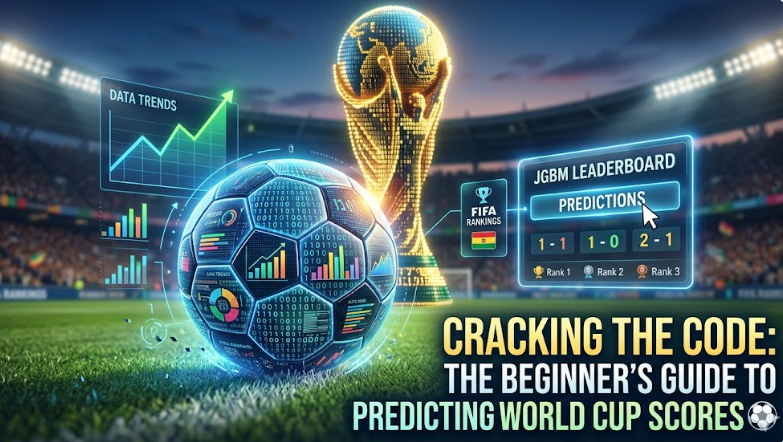
So, you’ve signed up for the internal JGBM World Cup Prediction Tournament, but your football knowledge begins and ends with knowing that players aren’t supposed to touch the ball with their hands.
Don’t panic! You don’t need to be a seasoned sports analyst to win a score prediction tournament. In fact, football data reveals a series of highly predictable patterns. While a sports fanatic might overthink a player’s minor injury or historical regional rivalries, you can leverage hard data to secure your spots on the JGBM Leaderboard.
Here is your data-driven cheat sheet to making smart, strategic World Cup predictions without watching a single minute of pre-match analysis.
1. Keep It Low: The “Magic Numbers” of Football
The biggest mistake beginners make is predicting chaotic, high-scoring baselines like 4–3 or 3–2. While those games are thrilling to watch, they are rare statistical anomalies.
Historical World Cup data shows that football is inherently a low-scoring, highly defensive sport.
- The Historical Average: Across the modern history of the Men’s World Cup, the average number of goals scored per match hovers consistently at around 2.5 to 2.6 goals (Almeida, n.d.; Baker & McHale, 2018). In the 2018 tournament, the average was 2.64 goals per match (Kubayi, 2020), and 2022 followed an incredibly similar pattern.
- The “Smart Money” Strategy: Because the average total is below three goals, your safest baseline prediction for almost any evenly matched game is 1–1, 1–0, or 2–1.
2. Lean on the Most Common Scorelines
If you are completely stuck on a matchup, pick one of the three most common scorelines in international football. Statistically, betting exchanges and historical data show that these three outcomes make up a massive chunk of all final results (Reade et al., 2019):
| Scoreline | Strategic Use Case |
| 1 – 1 | Use this for tight, high-stakes matches where neither team wants to lose (especially in the group stages). |
| 1 – 0 | The ultimate defensive standard. Use this when a slightly better team plays a highly defensive underdog. |
| 2 – 1 | Use this when there is a clear favorite, but the underdog is still capable of sneaking one goal past the keeper. |
The “Draw” Nuance: While predicting a tie is statistically very viable, mathematical models find that predicting a exact Draw is often tougher to pinpoint than an outright Win/Loss (Luo, n.d.). If you think it will be a draw, stick firmly to 1–1. Avoid 0–0 unless both teams are notoriously bad at scoring.
3. Check the Official FIFA Rankings (Your Shortcut to “Quality”)
You don’t need to guess who the favourite is. FIFA does the homework for you. Academic models analysing tournament outcomes heavily weight the formal FIFA World Rankings and historical performance metrics to accurately calculate success probabilities (Groll et al., 2015).
Before you submit your weekly sheet:
- Quickly check the official standings on the FIFA Men’s World Ranking Dashboard.
- If Team A is ranked #5 in the world and Team B is ranked #48, Team A is your clear favourite.
- Reflect this disparity in your scores: give the heavy favourite 2 or 3 goals, and limit the underdog to 0 or 1.
4. Group Stages vs. Knockout Rounds
The tournament structure changes how teams play, and your strategy should adapt to it:
- The Group Stages (Weeks 1-3): Teams are trying to accumulate points. Heavy powerhouse nations will occasionally run up the score against massive underdogs. Don’t be afraid to predict a 3–0 or 4–0 if a top-5 team plays a low-ranked qualifier.
- The Knockout Stages (Weeks 4-5): Lose, and you go home. Research shows that as the tournament progresses into the finals, playing styles become significantly more cautious and defensive (Baker & McHale, 2018). Teams minimise risk, meaning games get much tighter. Expect a flood of 1–0 and 1–1 results here.
Summary Checklist for Your Weekly JGBM Picks
- [ ] Did I make sure most of my total match goals add up to 2 or 3 goals?
- [ ] Did I utilise the 1–1, 1–0, and 2–1 safety nets?
- [ ] Did I check the FIFA World Rankings to identify the true favourites?
- [ ] Am I avoiding wild, unrealistic scorelines (like 5–3)?
By sticking to the numbers and keeping your scores low, you’ll easily bypass the over-analytical football fans in the office who let emotion cloud their predictions. Trust the data, lock in your scores, and enjoy the climb up the leaderboard!